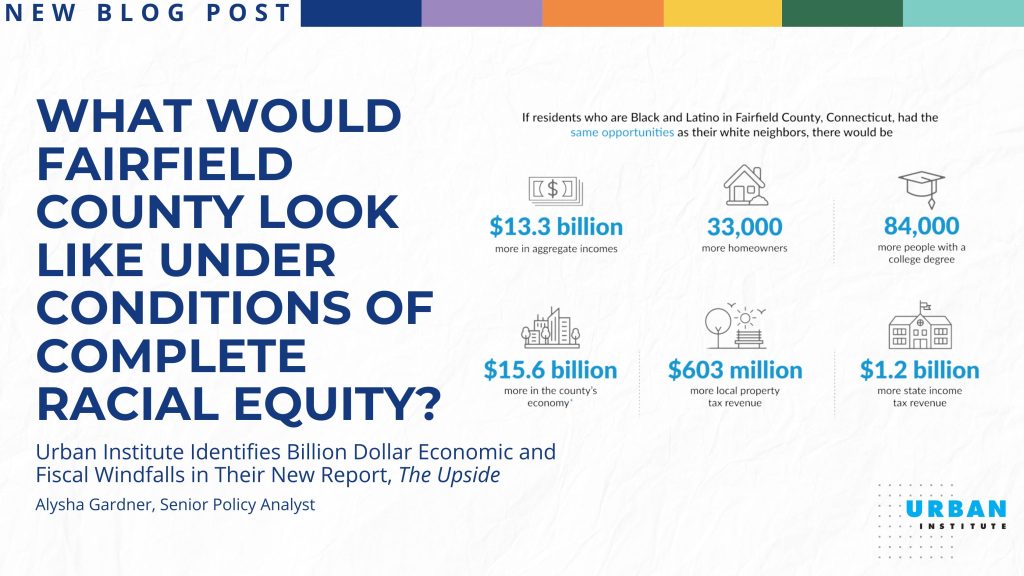
Urban Institute Identifies Billion Dollar Economic and Fiscal Windfalls in Their New Report, “The Upside”
By Alysha Gardner, Senior Policy Analyst
“Equity is neither a zero-sum game nor an inevitable condition of social and economic systems. Advancing equity does not necessitate losses for some; rather, it can produce substantial benefits for the economy as a whole.”
It’s official: as of the latest U.S. Census Bureau’s American Community Survey data release, Fairfield County has the second-highest rate of income inequity among all US metropolitan areas. As anyone who has spent time in both the Governor’s hometown of Greenwich and downtown Bridgeport can attest, levels of both socioeconomic and racial segregation are stark in the southwestern corner of the state.
Researchers at the Urban Institute, together with Data Haven, the Fairfield Community Foundation, and a coalition of community leaders in the state’s Equity Research Advisory Panel (including the Partnership’s own Policy Director, Sean Ghio) worked together to produce this report. They dared to imagine a world of perfect equity, where Black and Latino families had commensurate incomes, education levels, and homeownership rates as their White counterparts. Using advanced matching techniques on five years of deidentified individual records from the American Community Survey Census data, researchers created a counterfactual reality to explore the economic returns to equity.
The authors identify staggering economic implications: a $13.3B increase in incomes and a $15.6B increase to the county’s Gross Domestic Product (GDP). This economic boost would then be translated into $1.2B in increased state income tax revenue and a $600M increase in local property tax revenue. In addition to the very real cost for human life and dignity, housing and employment discrimination are a drag on the state’s economy – but with targeted policy investments, the economic potential for growth is substantial.
I’ve listed my five key takeaways from the report of things that surprised, intrigued, or motivated me in our housing policy work. Give the full report a read if you have the time – it’s excellent! – or read my highlights below:
Lesson #1: Why NIMBYs are Their Own Worst Enemies: The Primary Economic Beneficiaries of Fixing the Housing Crisis are the Towns Themselves
Lesson #2: How Homeownership Paid Your College Tuition: Racial Educational Disparities are a Direct Result of Our Exclusionary Housing Policies
Lesson #3: Why It’s Actually Racism: Population-Level Racial Economic Disparities Can’t Be Explained by Income or Education Alone
Lesson #4: How Our Neighbors Are Already Doing It Better: Fixing Racial Income Disparities in Fairfield County Is Completely Attainable
Lesson #5: Connecticut’s Flagship “Time to Own” Is Due for Major Reform: How Targeted Universalism Can Achieve Homeownership for All Racial Groups
Lesson #1: Why NIMBYs are Their Own Worst Enemies: The Primary Economic Beneficiaries of Fixing the Housing Crisis are the Towns Themselves
Researchers can highlight the “upside” of equity by making a direct link to the expected economic benefits. Equitable incomes across racial groups lead to increased GDP for Fairfield County (+$15.6B) and more tax revenue for the state ($1.2B).
However, the most direct economic benefit to towns and cities in Fairfield County is the expected $603M increase in property tax revenue from increased homeownership rates and home values for Black and Latino families. In context, this represents a 20% increase in residential property tax revenue across Fairfield County.
Potential tangible benefits of this tax revenue could include both tax relief:
Lowering mill rates for property taxes across the board
Tax relief for senior or disabled homeowners
Elimination of the motor vehicle tax
And reinvestments in the community:
Higher quality K-12 education, childcare subsidies, and better paid teachers
Green spaces, community gardens, and environmental sustainability efforts
High quality summer and recreation programs for youth and families
Improved road safety and infrastructure improvements
Localized housing down payment assistance programs
Incentive programs to attract prospective employers and cultural centers
What town wouldn’t want a 20% increase in residential property tax revenue? The irony is that towns – the main beneficiary of this equity – are also their own worst enemy. Exclusionary zoning practices are a main driver of housing scarcity in Fairfield County, which results in stark racial homeownership gaps. Simply allowing private developers to build more housing, relaxing zoning requirements, and allowing more homes of all types to be built will both increase the tax base and increase the value of existing homes, leading to direct economic and revenue benefits for these same towns.
Lesson #2: How Homeownership Paid Your College Tuition: Racial Educational Disparities are a Direct Result of Our Exclusionary Housing Policies
In exploring the educational disparities between Black, Latino, and White individuals, the researchers point out an important connection between housing and education that I hadn’t previously considered. I’ll quote the authors directly:
“National research shows that parental financial assistance for college explains one-third of the racial gap in educational attainment and that Black parents’ lower socioeconomic resources, due to a lack of opportunity to amass resources, explain almost all racial disparity in parental financial assistance. This is related to the inability of many Black households to purchase homes with favorable loan terms, since homeownership is one of the primary methods for amassing wealth in the United States.” (p. 20)
Inequitable homeownership rates – due to redlining, racial covenants, and current exclusionary zoning policies – are a direct cause of the racial difference in college graduation rates in Fairfield. This cycle repeats with lower educational attainment leading to less earning potential, fewer opportunities to own their own home, and an uphill battle to break intergenerational cycles. The alternative is also true – policy reform and investments in housing now will certainly result in better life outcomes across generations by allowing access to better K-12 school districts and increased opportunity to pay for college using wealth generated from homeownership.
Lesson #3: Why Its Actually Racism: Population-Level Racial Economic Disparities Can’t Be Explained by Income or Education Alone
On average, White households earn 2x as much as Black and Latino households in Fairfield County – $175K compared to $86K and $85K, respectively. National data shows that the wealth gap is even wider than the income gap: in 2024, Black families had $0.23 and Latinos $0.19 for every $1.00 in wealth held by White families. What is more astonishing, however, is the persistence of this gap even when educational and homeownership gaps are closed and narrowed.
White adults earn significantly more than Black and Latino adults regardless of educational attainment. In fact, Black and Latino adults with graduate degrees in Fairfield County still earn less than the average White adult with a high school diploma.
The racism gap persists into homeownership trends as well. At all income levels, White families in Fairfield County are more likely to own their home (bringing with it greater wealth and housing stability) than Black and Latino families. For instance, 67% of all White families making less than 100K own their home, compared to 29% of all Black families and 28% of all Latino families.
In pursuit of homeownership, Black applicants are twice as likely to be denied a mortgage as White applicants in the Fairfield County area when both make under $100K. Nationally, researchers have found that this gap persists even when controlling for credit scores. Black and Latino borrowers receive higher interest rates, were more likely to be offered subprime loans in the earlier 2000s despite similar household profiles to White families, and have lower appraisal values for homes of comparable size and amenities.
Lesson #4: How Our Neighbors Are Already Doing It Better: Fixing Racial Income Disparities in Fairfield County Is Completely Attainable
When I began reading this report, I admit to some skepticism on my part. Given our country and state’s history of racial discrimination, I had a difficult time envisioning a Fairfield County where income gaps between White and minority households were fully eliminated. This doesn’t ignore the need to pursue this reality as our highest ideal – but I struggled to believe the goal was realistic within my lifetime.
The authors, perhaps anticipating this skepticism, also modeled the benefits of “partial equity.” Instead of eliminating the racial income gap entirely, what would Fairfield County look like if we could achieve equity of a comparable U.S. county?
Enter Middlesex County, New Jersey:
Our fellow tri-state member, New Jersey, has a “twin” of Fairfield County in Middlesex County – similar total population levels, similar median household income, and similar proportion of Black and Latino households. Most importantly – they are both major suburbs of New York City. However, the racial income gaps in each county are radically different: while White households in Connecticut have incomes 1.5x the level of Black and Latino households (140% and 150% greater), in New Jersey, White incomes are 25% and 60% greater than the same racial groups.
The report authors modeled that if Fairfield County matched equity levels of Middlesex County, the average Black income would nearly double and Latino income would increase by 50%. Altogether, this partial closure in Fairfield County would lead to GDP increases of $6.8B.
Any racial discrepancy is a cause for concern; however, the fact that Middlesex County is approaching racial income parity shows us that progress is not only possible, but realistic. Fairfield County is not on an unchangeable trajectory set by historical redlining and cemented by geography. Rather, political will to shift housing and educational policy can and should lead to rapid equity increases and economic growth in the not-too-distant future.
Lesson #5: Connecticut’s Flagship “Time to Own” Is Due for Major Reform: How Targeted Universalism Can Achieve Homeownership for All Racial Groups
This report introduced me to a new phrase: “targeted universalism.” In a nutshell, policymakers work towards a universal goal for all residents (say, homeownership) and create targeted policies tailored towards the specific challenges and needs of sub-groups within the larger group. A single-parent household has different needs from a recently married couple, which has different needs from a senior on a fixed-income. Each group has different homeownership rates, and enabling or preserving homeownership opportunities for each group will require different strategies. (Watch this short video for a great explainer on targeted universalism).
One fantastic example of a targeted universalism homeownership program is the Homeownership Equity Fund CT program. The program provides zero-percent loans for downpayment and closing costs to first-time BIPOC homebuyers making up to 80% AMI. Additionally, the Housing Development Fund also provides homeownership counseling and education alongside the loans. From CEO Kiley Gosselin, “These funds will be recycled indefinitely to help countless families int eh HArtford area achieve the stability and wealth-building opportunity that homeownership provides.” Funded by the Hartford Foundation and implemented by Community Development Finance Institute (CDFI) The Housing Development Fund, this program is also a model of how private philanthropy and business can work together to address housing gaps in Connecticut. As recommended in the Partnership’s 2022 policy brief, “Building a More Equitable Homebuying System: Actions to Support BIPOC Homeownership in Hartford,” a privately funded BIPOC downpayment program could help correct historic discrimination in housing opportunities in ways that are not permitted with public funds.
On the other end of the spectrum, the state’s Time to Own (TTO) Program, which provides $25K in forgivable downpayment assistance for low- to moderate-income first-time homebuyers, is an example of a (mostly) universal program. While there are some eligibility requirements and income caps, thousands of households across Connecticut are eligible. What would it look like to design Time to Own under a targeted universalism lens, focused on helping achieve equitable homeownership rates for Black and Latino households?
The racial homeownership gap in Fairfield County is abrupt at all income levels, but especially in the $0-$99K income bracket. Any downpayment assistance program would hopefully target Black and Latino families which make less than $100K. However, examining the state’s Time to Own dashboard in the Metropolitan and Western Planning Regions (a rough analog to Fairfield County) highlights that nearly one-third of all loans go to borrowers making above $100K, and White residents make up between 30-45% of all recipients. The goal of homeownership for all will sadly bypass racial minorities in this state if there is not a concentrated effort to appropriately target homeownership policies.
Connecticut policymakers should consider modifying Time to Own to become a first-generation (first-gen) downpayment assistance program. First-time homebuyer programs, like TTO, provide subsidies to households who may also have the financial support of parents who have accumulated wealth through their own homeownership; in contrast, first-gen programs target downpayment assistance to those whose parents do not own their own home. First-gen programs are recognized as an effective policy tool in building housing equity and reversing the generational effects of housing discrimination. Among our neighboring states, Maine, New Jersey, Vermont, Rhode Island, and Massachusetts all have first-generation homebuyer assistance programs. With genuine legislative and executive excitement in Connecticut around the Time to Own Program, it’s time to target the benefits towards prospective homebuyers facing the highest institutional and systemic barriers.
We All Have a Role to Play
“Equity is neither a zero-sum game nor an inevitable condition of social and economic systems. Advancing equity does not necessitate losses for some; rather, it can produce substantial benefits for the economy as a whole.”
This report offers a glimpse of a world where our Black and Latino Connecticut neighbors are afforded the same rights and privileges their White neighbors. We can envision a true equity, where patterns of current discrimination are interrupted and past discrimination are remedied. The researchers demonstrate with data what most of us instinctively know: that the community as a whole benefits from the uplift of the marginalized.
Front and center in the findings was a beautiful graphic on what policies can make a difference as we move towards full equity in Fairfield County. Find yourself below!
Research shows that new housing, even market-rate housing development, does not worsen housing costs, cause gentrification, or significantly increase the displacement