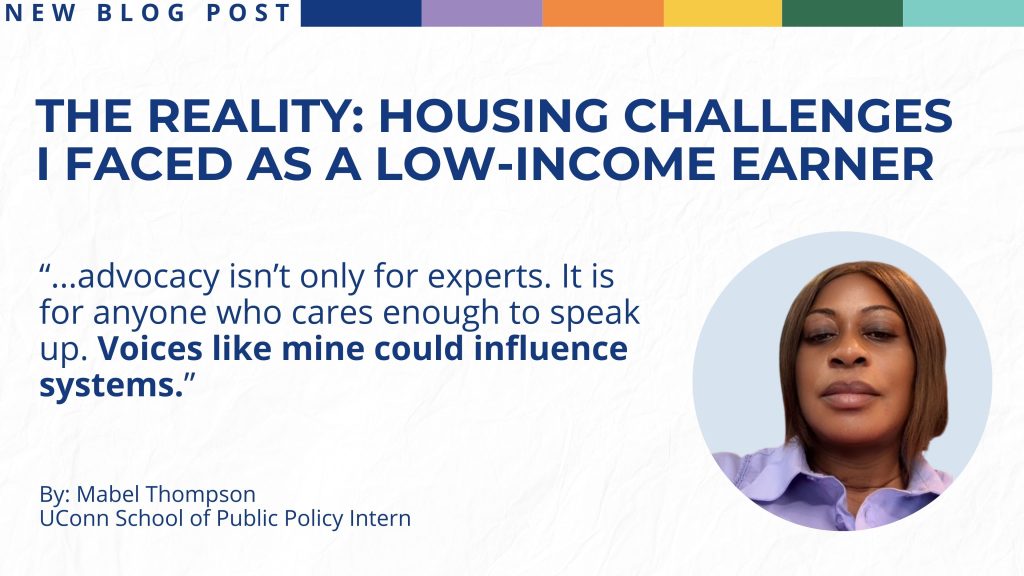
By: Mabel Thompson, UConn School of Public Policy Intern
Like many low-income earners, I have faced the ongoing challenge of finding affordable and decent housing. For the moment, I have an affordable rental in East Hartford, Connecticut, but East Hartford, like numerous other cities, faces some serious housing challenges that demand urgent attention. My challenge has been my limited income, while also being a full-time student in the UCONN Master of Public Administration program and raising a preschool-aged child.
The stark reality is that housing costs keep escalating while incomes remain stagnant, making it increasingly difficult for me to secure a safe and comfortable home. According to a United Way ALICE report (Asset Limited, Income Constrained, Employed), over 39% of households live below the ALICE threshold- meaning they earn too much to qualify for public assistance but not enough to afford the basic cost of living.1 Low-income working and
studying parents, especially single heads of households, are one of the primary population groups needing housing assistance to secure a safe, stable rental home. Rental aid would help to reduce financial strain, allow more focus on advanced education and employment opportunities for these parents, and allow them to concentrate on their children’s well-being and eventually save for the future. It is not unusual in Connecticut for housing costs to exceed 50 percent of ALICE2 incomes. This situation leaves families with limited funds for other expenses, such as food and healthcare. The most important part of the American Dream is being able to have opportunity, but Connecticut is making that increasingly impossible.3
When I first started searching for a place to live, I knew it wouldn’t be easy, but I didn’t expect just how long and frustrating the process would be. At certain times, I have had to share apartments with others to survive. That was my story. While searching for my current apartment, which is a 2-bedroom apartment that I share with my daughter, every affordable listing seemed to disappear before I could schedule a tour, and so many places had income requirements that I could not meet. I spent late nights scrolling through rental sites after work, determined to find something that would work. There were moments of exhaustion and doubt, but I kept pushing forward by calling different leasing offices, asking friends for leads, and learning more about rental assistance programs. It wasn’t easy, but I refused to give up. And through that persistence, I eventually found a place to call home.
How can this challenge be navigated?
Governments and policymakers play a vital role in ensuring affordable housing options are accessible. This includes adopting policies like rental assistance, inclusive zoning, and subsidies for low-income earners, to name a few.
Rental aid programs like Connecticut’s Rental Assistance Program can help low-income renters afford their homes. The state covers the difference between the tenant’s payment and the actual rent charged by the landlord (up to a fair market rent limit) and this allows workers earning minimum wage or slightly above to access safe and stable housing. The number of eviction filings in a town reduces as the number of rent-assisted households increases.4
With a voucher, tenants may be able to choose homes they desire, for example, private market apartments, single–family homes, or townhouses that meet program requirements. By reducing housing costs, government-funded initiatives help low-income individuals and families pay rent for safe and decent housing. Vouchers help prevent homelessness and allow families to use their income for essentials like food, healthcare, and education.5
What Can Policy Makers Consider?
Thousands of low-income parents are striving to build better lives through education. To support them, policymakers might consider expanding and streamlining subsidies so student-parents can attend classes and work without having to worry about safe, reliable care for their children as well as promotion of hybrid and evening class options, affordable tuition, wrap-around supports like tutoring, career counseling, and transportation assistance and affordable housing initiatives and rental assistance programs that prevent student parents from having to choose between education and a place to live.
My Experience as an Intern in a Housing Advocacy Space
Each month as an intern, I attended virtual calls hosted by organizations like the National Low Income Housing Coalition (NLIHC), joining their State and Tribal Partners call, and their Opportunity Starts at Home meetings to learn and share information with my team at the Partnership for Strong Communities. At first, I felt out of place. Most of the faces on my screen were professionals — policy analysts, nonprofit leaders, housing developers. But then I realized, I belong in these spaces too. My lived experience is part of the policy puzzle they’re trying to solve.
During one session, a speaker from NLIHC shared updates on federal housing legislation, explaining how rental assistance programs are funded and what gaps remain. Another time, OSAH showcased local supportive housing initiatives that help people transition from homelessness into permanent homes. What struck me most was that these calls weren’t just abstract policy talk— they were about people like me, my family, and my neighbors. This internship didn’t just build my résumé, it built my confidence. It reminded me that advocacy isn’t only for experts. It is for anyone who cares enough to speak up. Voices like mine could influence systems. Given that, in collaboration with the Park City Community Team in Bridgeport, I helped plan a site visit to the Charles F. Green Homes that will highlight their accomplishments in housing policy, funding awards, and community planning by showcasing real conditions, resident experiences from improvements, community support, and the connection between local programs, community leaders and city council members.
Despite the challenges surrounding available housing vouchers and limited housing stock, there are several reasons for hope and progress in making housing more accessible and equitable. During my internship, the Partnership for Strong Communities has been advocating for policies that could improve the housing landscape for me and many other Connecticut residents, making affordable rental or ownership opportunities more accessible. Partnership for Strong Communities’ advocacy at the state legislature gives me hope.
Sources
[1] unitedforalice.org/connecticut
[3] Opinion: An affordable and opportunity-rich Connecticut needs more homes
[5] The Benefits of Housing Vouchers – Partnership for Strong Communities