
By: Kelly Giordano, Managing Director, Philanthropy Office of Corporate Responsibility
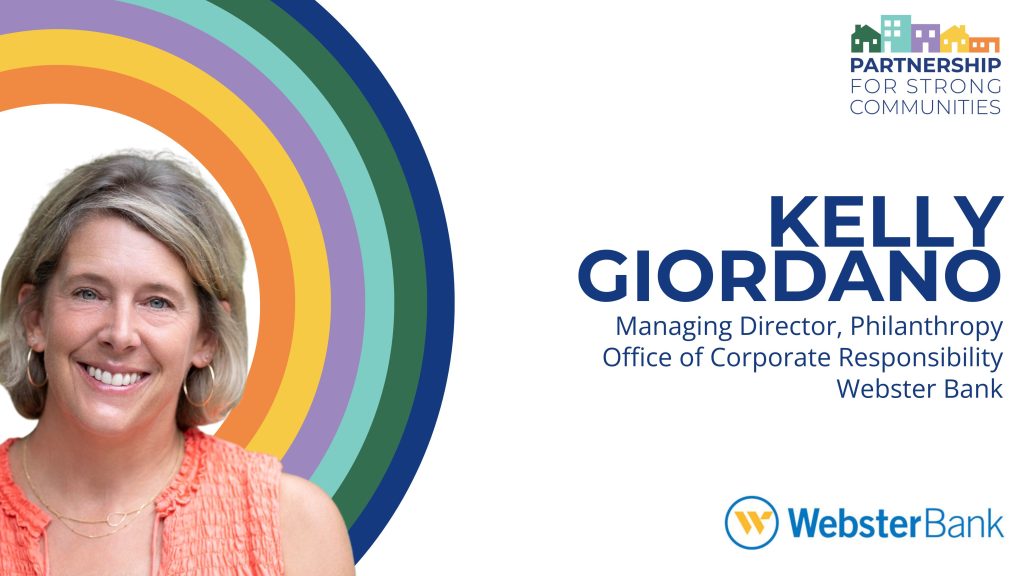
Q: Can you share a bit about your background and how you came to be at Webster Bank?
My path to philanthropy was anything but traditional. I didn’t start out in this field—in fact, it wasn’t even something I considered while in college as I wasn’t aware it was an option. My career began at Goldman Sachs in a finance role supporting trading desks which I loved. During my time at Goldman, I did a lot of volunteering through their Community TeamWorks program and on my own. I then found out about Goldman’s charitable contributions group and foundation and realized that giving back for a living was actually an option. I knew I wanted to get into philanthropy, but thought it was important to first have some nonprofit experience.
I left Goldman for an unpaid internship at WNET/Channel 13 in New York City while working at a wine store to pay my bills. That led me to the Metropolitan Museum of Art, where I worked in the development office managing the corporate patron program. My experiences at both places were invaluable learning about the roles of staff and board members, fundraising, and the major challenges nonprofits face.
Later, I joined Lehman Brothers, which at the time didn’t have a philanthropy team. I was hired with two other people to build their corporate social responsibility program from the ground up – from foundation grantmaking, corporate sponsorship, employee giving campaign, to nonprofit board training and placement. It was an amazing learning experience. After that, I spent 11 years at Newman’s Own Foundation managing their global grantmaking among other grant programs prior to joining Webster in 2023. This June marks my second year here, and I feel incredibly fortunate to be part of the Webster Bank team and for the experiences and opportunities I’ve had along the way.
Q: What is important to you about Webster Bank’s mission, and how does it align with the Partnership’s mission?
Webster Bank’s regional footprint is deeply personal to me. I grew up outside Hartford and raised my kids in Norwalk, so being part of a bank that was founded in my home state of Connecticut is very special to me, and I have personal ties to the other geographic areas in our footprint – Rhode Island, Massachusetts, New York City and Long Island. And a regional footprint allows me to be closer to the work and focus on local communities.
I also love how our funding pillars at Webster Bank are very clearly tied to who we are as a bank: Community Development, Workforce Development, and Financial Empowerment. These pillars ensure that our funding directly reflects our mission as a bank. Whether it’s supporting pathways to homeownership, financing affordable housing projects, or strengthening financial literacy, our approach is intentional. Our community development pillar in support of affordable housing is squarely aligned with the Partnership’s mission of working to ensure that affordable, safe, and stable housing is available for all – without it, no one and no family can thrive.
Q: What have you found most inspiring or noteworthy about the work that the Partnership does?
Webster Bank has been a proud supporter of PSC since 2014. What I find most inspiring about the Partnership’s work is its mission and ability to convene and connect different entities across CT together to collaborate, whether through shared intention, shared measurement, mutual reinforcement, or communication. No one organization can accomplish major change alone, especially when there are many players and when the challenges are complicated and seem insurmountable. The ability to bring people together via a shared mission is necessary and the Partnership’s role is invaluable.
Q: How do you measure success in the projects you support, and what outcomes have been most notable?
Measuring impact in philanthropy is always a complex topic because so much of the change we all aim for is long-term, and there are always many external variables to consider. Each of our funding pillars is unique, also making it difficult to apply a one-size-fits-all metric to our entire portfolio. Real change often takes decades, and we’re also humble enough to recognize that we’re never the only funder involved in any given initiative. Collaboration is key.
While we can look at quantitative KPIs, I also like to focus on and feel inspired by qualitative stories of individuals whose lives have been changed for the better. It’s about seeing a single mom move into a safe home for her children, or watching someone transition from incarceration to stable employment and being able to provide for their family. These stories demonstrate the tangible impact of our work. While systems change is difficult to measure, we know that the work we support on the ground being done by organizations like PSC is making a difference in people’s lives.