
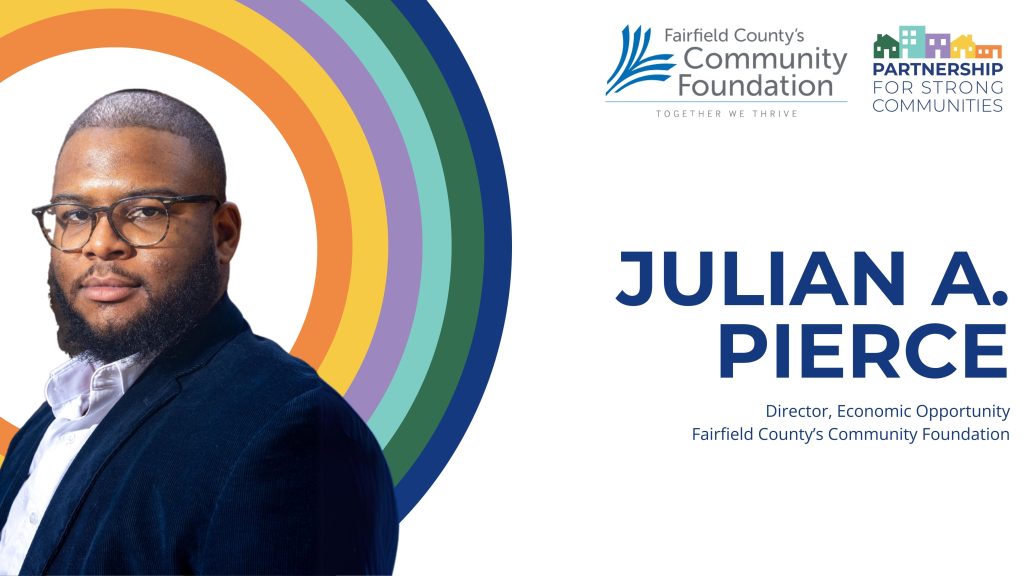
By: Julian A. Pierce, Director, Economic Opportunity, Fairfield County’s Community Foundation
Talk a little bit about your background/history and how you came to be at Fairfield County‘s Community Foundation.
After completing my undergraduate degree at the University of Miami, I got a position at a local nonprofit that was focused on housing affordability and affordable housing property development. I worked as a pre-purchase and loss mitigation housing counselor where I performed grant oversight, helped prepare individuals for first-time home purchases through education, led trainings on financial sustainability and more. In the summer of 2017, after graduating with my masters in community program development from University of New Haven, the Community Foundation was looking for an associate level employee that had housing experience. As much as I had enjoyed housing counseling, it was also incredibly emotionally taxing, particularly the foreclosure and loss mitigation side, so it felt like the right time to jump into this opportunity.
What is important to you about the Community Foundation’s mission, and what are the ways that mission aligns with the Partnership’s mission?
I grew up in Stratford, Connecticut and saw a lot that I didn’t understand- why some areas were cleaner than others, why some areas were more taken care of than others, why some homes were closer to certain resources than others, etc. As a kid I had no framework to make sense of poverty or economic disparity, but I always felt curious about those differences. I hope to have some impact on the negatives I saw growing up by utilizing my skills and education. Issues of access and affordability shouldn’t be so pervasive in a state with such a deep capacity to serve its residents like Connecticut.
The Partnership’s mission and its use of words like “equity and diversity” align directly with the Community Foundations’ and with my own. We are two organizations laser focused on righting the historical wrongs of housing injustice that are perpetuated by bad information, bad policies and unfortunately bad actors as well.
What have you found most inspiring or noteworthy about the work that the Partnership does?
I really appreciate the Partnership’s dedication to housing affordability and addressing homelessness. Folks like us were doing it before it was cool, and I appreciate that consistency and willingness to collaborate with a wide swath of stakeholders. The Partnership works with so many different organizations with varying levels of expertise on the intricacies of housing policy and how we got where we are. I appreciate how they talk about complex issues in a way that’s forthright and digestible to people outside of the housing space. Philanthropic organizations don’t always do that so well and it’s important to bring information to people on the ground level who aren’t always thinking about housing and housing affordability so they can see themselves at the root of the solution.
How do you measure success in the projects you support, and what outcomes have been most notable?
The Community Foundation utilizes results-based accountability (RBA) to measure success in the projects we support. For our grantee partners we start at the high-level with population results that they seek to have influence over the long-term vis-à-vis some specific program. For example, a homeless service organization might have a population-level goal of ensuring all forms of homelessness are rare, brief and nonrecurring.
All grantees start from a different place, so our role varies and includes identifying the best indicators associated with their missions. Most often we’re translating an organization’s program design into three specific categories:
- How much did the organization do? (Quantity of effort)
- How well did the organization deliver their program? (Quality of effort)
- Is anyone better off from the program? (Impact)
I’d say the most notable outcomes from our grantmaking, and our community partnership has really been around narrative shift. We’ve supported consistent messaging around key issues like housing affordability along with our partners to ensure correct information is available to all who seek the truth about the issue and the barriers that are perpetuating the lack of access to economic opportunities. In years past there seemed to be more of a pervasive false narrative around housing costs, what happens when new housing is built, the kinds of people who occupy certain types of housing, etc. And now there seems to be broader consensus that the lack of affordable housing options is extremely detrimental to our state in terms of workforce development, education opportunities, retaining our deep talent pool, public health, etc. Even though that’s less tangible than RBA, there’s been no greater joy, in my role, than to see the public narrative around housing shift from a “problem for those people” to an economic imperative for the solvency and growth of our state.